News
the2030climatepackagewillcosttheofficesector€1.5billion

The Dutch property market aims to make the built environment fully Paris-compliant by 2050. A comprehensive data analysis by property consultancy Envalue, in which 4.9 million properties were linked to an energy performance certificate, has examined the sustainability status of the built environment in the Netherlands. This reveals that the sustainability challenge for offices is significant, as only 63% of office space complies with the supplementary Dutch climate package for 2030, which was adopted by the government last year. Envalue has calculated that over the next six years, 1.5 billion euros will be needed just to bring the office market into compliance with Dutch regulations, let alone make it Paris-proof by 2050.
High costs of making the built environment more sustainable
Currently, 55% of office buildings in the Netherlands have an energy rating of A or better. Envalue used a price per square metre based on energy rating to calculate how much it would cost to upgrade offices with energy ratings G to B to an A rating. In total, this involves more than 18 million square metres that still need to be made sustainable. According to Envalue’s analysis, the expected investment to bring this office space up to A-level by 2030 – in line with the ‘Fit for 55’ guidelines – amounts to approximately 1.5 billion euros.
To meet the standards of the Paris Climate Agreement, the entire office stock must be brought up to energy label A+++ level. This means that a total investment of approximately 4.5 billion euros is required to make the existing office stock Paris Proof.
In addition to the office sector, Envalue has produced a broader estimate for residential property: it will cost around 195 billion euros to bring the entire housing stock up to energy label A by 2050. Around 65% of the existing housing stock still needs to undergo sustainability improvements to achieve at least energy label A.
Jan Verhaegh, CEO of Envalue Real Estate: “These investments currently seem unfeasible, partly due to rising interest costs and the available capacity in the construction sector. Another question that arises is: who is going to pay for this? The owners, the tenants or the government? Making the built environment more sustainable is certainly also a political issue that needs to be taken into account in the current government formation.”
Data drives concrete action
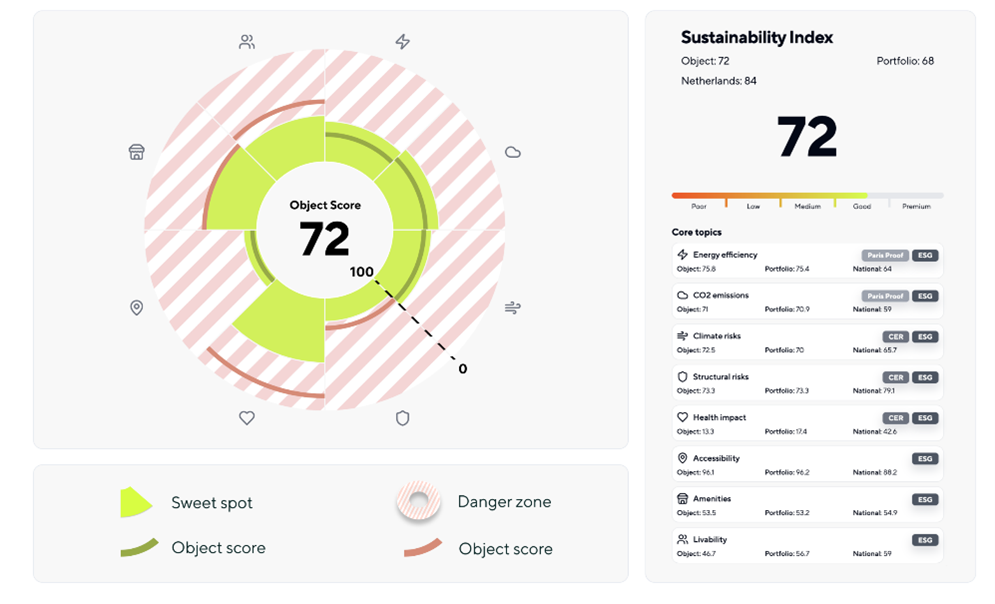
Envalue has incorporated the concrete figures and analyses into the already launched Paris Proof Platform. This platform, featuring an integrated data dashboard, displays the current status of the built environment and progress towards Paris Proof targets. By providing additional insight, Envalue hopes to create a greater sense of urgency among all stakeholders in the property sector, so that they actually take concrete steps. Verhaegh: “Banks are already playing a crucial role by imposing sustainability conditions on the financing of commercial property. But the government, too, can, for example, draw up concrete standards with associated timelines and shorten and simplify planning permission processes for sustainable renovations. Finally, it is important that property consultants factor the impact of future sustainability investments into property valuations.”